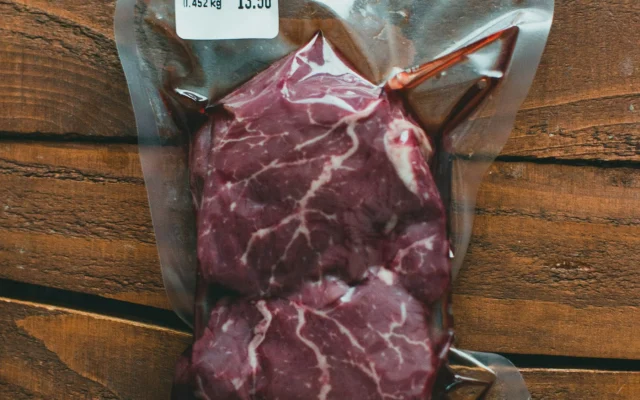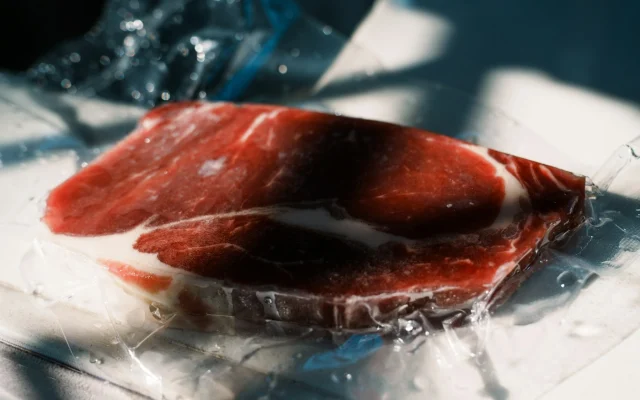
- External (suction) sealers need embossed/textured bags or rolls.
- Chamber sealers use cheaper smooth pouches (embossed bags work too, but cost more).
- Rolls are the most flexible; pre-cut bags are faster.
- Match the bag width to your sealer’s maximum (usually about 11–12 in on home external sealers).
Embossed bags vs smooth pouches
An external sealer pulls air out through the bag’s open end, so one side of the bag needs a textured, channelled surface for air to travel along. These are called embossed (or textured/channel) bags. Without the texture, the bag’s walls stick together and trap air.
Chamber sealers evacuate the whole chamber, so they don’t need channels and can use smooth pouches, which are generally cheaper. You can use embossed bags in a chamber sealer, but not smooth pouches in an external one.
Rolls vs pre-cut bags
| Rolls | Pre-cut bags | |
|---|---|---|
| Flexibility | Any length — great for fillets, ribs and odd shapes | Fixed sizes (pint, quart, gallon) |
| Speed | Two seals per bag (bottom, then top) | One seal — faster for repeated portions |
| Waste | Minimal if you cut to size | Can waste plastic on small items |
| Best with | Sealers with a built-in cutter and roll storage | Any sealer; good for meal prep |
Many households keep an 11-inch roll for custom bags plus a box of quart bags for everyday portions. Use our bag size calculator to work out the cut length for any item.
Common sizes
- Pint — single servings, nuts, herbs.
- Quart — about 1 lb of ground meat pressed flat, two chicken breasts.
- Gallon — roasts, family portions, larger fish.
- 8 in and 11 in rolls — fit nearly all home external sealers.
- 15 in rolls — only for sealers with a seal bar at least that long.
Thickness and quality
Bag thickness is usually given in mils (thousandths of an inch). Thicker bags resist punctures from bones and freezer handling better. Whatever you buy, look for bags labelled BPA-free and suitable for freezing, microwaving (check temperature limits) and simmering or sous vide if you plan to cook in them.
Pad sharp bones with a folded paper towel or a small piece of bag before sealing — it’s cheaper than double-bagging and prevents slow leaks in the freezer.
Brand compatibility
Most external sealers will seal any brand of embossed bag within their maximum width — the Nesco VS-12, for example, accepts any brand of vacuum bag up to 11.8 inches. A few manufacturers recommend their own bags for the most consistent results; Inkbird, for instance, notes that its INK-VS02 works with most textured bags but recommends Inkbird bags. If seals fail with a new bag brand, try another before blaming the machine. See why your vacuum sealer isn’t sealing.
Are reusable vacuum bags worth it?
Reusable zipper bags with a one-way valve, used with a handheld pump or an accessory port, are good for leftovers, cheese, marinating and short-term fridge storage. They’re washable and cut plastic waste. For long-term freezer storage of meat and fish, heat-sealed bags remain the more reliable choice. A cordless pump such as the Zwilling Fresh & Save works only with its own valve bags and containers.
Zwilling Fresh & Save Vacuum Pump
A cordless, USB-rechargeable handheld pump for reusable Fresh & Save valve bags and containers — small enough for a drawer, ideal for leftovers and meal prep rather than long-term freezer sealing.
- Sealer typeHandheld
- Vacuum settingsOne-button pump
- Seal barNo heat seal (valve bags)
- Built-in bag storageN/A
- Bag cutterN/A
- Accessory portN/A
- Cordless, USB-rechargeable
- Reusable bags and containers
- Drawer-sized (about 7.5 in tall)
- Works only with valve bags and containers — no heat sealing
- Not a substitute for a countertop sealer for long freezer storage
Affiliate link. Prices and availability change — check Amazon for current details.
Can you reuse heat-sealed bags?
You can wash and reuse bags that held dry goods, fruit or vegetables if they’re intact — each reuse costs a little length when you cut the old seal off. Don’t reuse bags that held raw meat, fish, eggs or greasy foods, or bags that have been simmered, because they’re hard to clean thoroughly.
Shopping for bags on Amazon
Search by the width your sealer supports and the type you need:
Compare 11-inch rolls on Amazon (opens Amazon in a new tab)
Compare quart bags on Amazon (opens Amazon in a new tab)
Compare chamber pouches on Amazon (opens Amazon in a new tab)
Frequently asked questions
What bags work with vacuum sealers?
External sealers need embossed or textured vacuum sealer bags or rolls; chamber sealers can use smooth vacuum pouches. Regular zip-top freezer bags won’t vacuum seal in a countertop machine.
Are generic vacuum sealer bags as good as brand-name bags?
Many generic embossed bags work well, provided they fit your sealer’s width and are rated for freezing. Quality varies by thickness and texture, so if you get failed seals, try a different brand.
Can I vacuum seal in regular Ziploc bags?
Not with a countertop heat sealer. Use bags made for vacuum sealing, or reusable valve bags designed for a handheld pump.
Affiliate disclosure: As an Amazon Associate, we earn from qualifying purchases. This does not affect our editorial opinions or recommendations. Learn more.